Introduction
The future of tech looks bleak. The world seems to be heading towards a dystopia where technology is used to control the masses and extract as much value as possible from our attention. The large capitalist machine has swallowed us all. AI predictions are alarming, and the danger looms great. It all seems hopeless. Our world is starting to resemble the dystopian worlds of Blade Runner or Black Mirror, making it increasingly difficult to distinguish between nightmares and reality. This is why we need Solarpunk.
What is Solarpunk?
Solarpunk is an artistic, cultural, and technological movement that envisions a future defined by a harmonious relationship between people, nature, and technology. The 'Solar' in its name reflects a world powered by renewable energy, where sustainable technology is integral to building collaborative communities that thrive in balance with the environment.
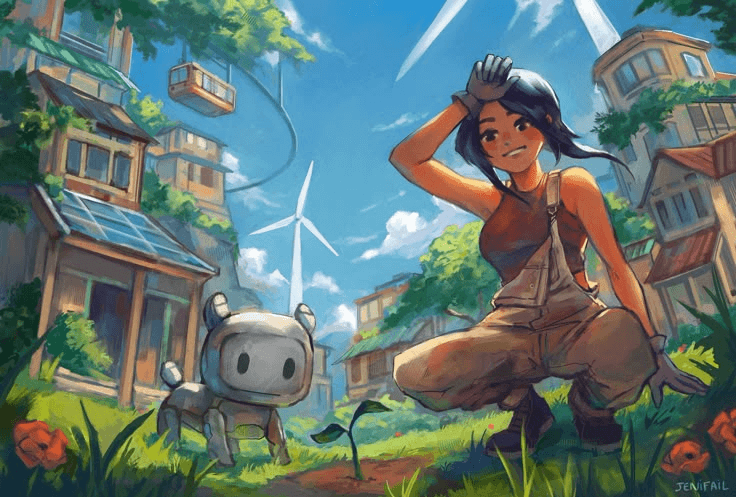
In a world where our imagination is flooded with dystopian imagery, we need such a vision to strive for. The possibilities we are aware of are limited by what we can imagine. Therefore, a vision for a bright future has never been more important in today's world.
But Solarpunk is not just a vision. It asks an important question: How can we create a world that we want to live in?
Solarpunk is not only an artistic and cultural movement, but it's also a practical examination of what steps we need to take to create the future that we envision. At its core, it's a technological movement, a revolution in how we view technology as a tool that integrates with nature instead of trying to exploit and control it. We need to critically examine our culture around technology. The extractive approach we've taken is failing, driving us to the brink of an ecological crisis that may lead to our extinction. For people like us in tech, this is our urgent call to action.
The Solarpunk Tech Stack
Harmony and community are at the core of Solarpunk. This is reflected in the technological aspect of the movement as well. The Solarpunk technology is freeing instead of restrictive, value-creating instead of extractive, community-driven instead of authoritative, and above all, it integrates harmoniously with us and our environment. Many software paradigms exist in today's world that embody some of these attributes. In my opinion, these are the most promising ones that we can adopt to empower a Solarpunk world:
1. Open-source software
Free Open Source Software is an important embodiment of the Solarpunk ethos. It is a paradigm of software development where the community of software users takes ownership of developing and maintaining the software. It is open to all, free to use and free to contribute to. Naturally, a group of core maintainers of the software, the main contributors, will decide on major decisions. But feature development, bug reporting, and maintenance are done by the community. This makes it a quintessential example of Solarpunk values in the real world. It is not only experimental or theoretical – Open Source Software powers most of the tech in our world.
2. Peer-to-peer protocols
Peer-to-peer (P2P) computing or networking is a distributed application architecture that partitions tasks or workloads between peers. This paradigm has decentralization as a core aspect of its design. Computational resources can be pooled together to achieve larger objectives and handle bigger loads. It can also be used for file storage and sharing, where a piece of content is stored and shared across multiple peers, which has plenty of advantages, like eliminating the need for central coordination by servers and maximizing availability. One famous example of this protocol in the real world is the BitTorrent protocol, which is a revolutionary tool in its own right.
3. Artificial Intelligence
AI is one of the most important tools central to Solarpunk. It can do so much to automate many of the tasks that are essential to sustainable living. It is a productivity multiplier since it can offload a lot of jobs that humans traditionally do. From recognizing patterns and making predictions to optimizing food supplies, designing cities, predicting economic trends, and so much more, to being a personal assistant to help us learn, grow and be more productive. It allows us to focus on what makes us human: our connection to each other and to nature, art, culture, and the pursuit of wonder. But AI is a double-edged sword. It is of utmost importance that we recognize how to use it safely. The values of the Solarpunk movement could be the key to safe and sustainable AI, making the two interdependent and complementary.
4. Crowdsourcing data
Data is the new oil. It is the fuel that powers the modern age, where our attention is the currency. But our data does not belong to us. We have surrendered it, willingly or not, to corporations that will only exploit it for profit with no regard for the harm this poses to us. One of this century's most important civil rights fights will be the fight for the right to own our data. Crowdsourcing is a way of collecting data from the masses, where people volunteer their data to power large systems that run on the intelligence of the masses. This can be exploitative too, which is why this needs to be accompanied by the acknowledgment and protection of our right to own our data.
5. Blockchain
Another great tool that can serve the principles of the movement is the Blockchain. At its core, Blockchain is a distributed-computing paradigm that is designed to achieve consensus through the participation of multiple nodes in a decentralized network. It helps us implement a system where money and ownership of assets can be achieved without a central authority. This democratizes the economy and participation in it to a great extent. In its most optimistic vision, blockchain can be a driver of many aspects of civilization in a decentralized, community-oriented way.
The above is not an exhaustive list. There is so much more tech involved, including the solar tech and the myriad of tools we need to make our living sustainable.
What can we build?
In addition to paradigms, we also need visions of sustainable tools that we can start creating right now. Here are some examples from the fields I specialize in, Data Engineering & AI:
Data Engineering as Digital Gardening
Think of Data Engineering as the practice of digital gardening. Instead of building massive data pipelines to serve corporate advertisers, we can build small, resilient systems to serve our neighbours.
Instead of: Data lakes for a mega-corporation.
Imagine: A "data pond" for a neighbourhood that tracks shared resources, like a tool library or a community pantry, ensuring everyone has what they need.
The Goal: To use data to foster resilience and eliminate waste on a local scale.
AI as a Community Brain
Artificial Intelligence doesn't have to be a mysterious, centralized black box. We can build smaller, transparent AI models that act as a "community brain."
Instead of: An AI that predicts what you'll buy next.
Imagine: An AI that helps a community garden predict local weather patterns to conserve water, or an AI that helps a local maker space optimize its solar panel usage.
The Goal: To use AI to augment community intelligence and solve meaningful local problems.
These are the topics we can explore. The project ideas are endless!
- Running AI models on a tiny, solar-powered Raspberry Pi.
- Building community-owned data platforms that respect privacy.
- Designing software that strengthens local economies and ecosystems.
Conclusion
To make this optimistic vision a reality, we need the collaboration of pioneers from so many different fields: renewable energy experts, engineers, policy-makers, philosophers, artists, and many more. For us in tech, our participation is integral. Let's work together, as tech enthusiasts and professionals, to leverage our skills and creativity towards this great vision of a bright future.